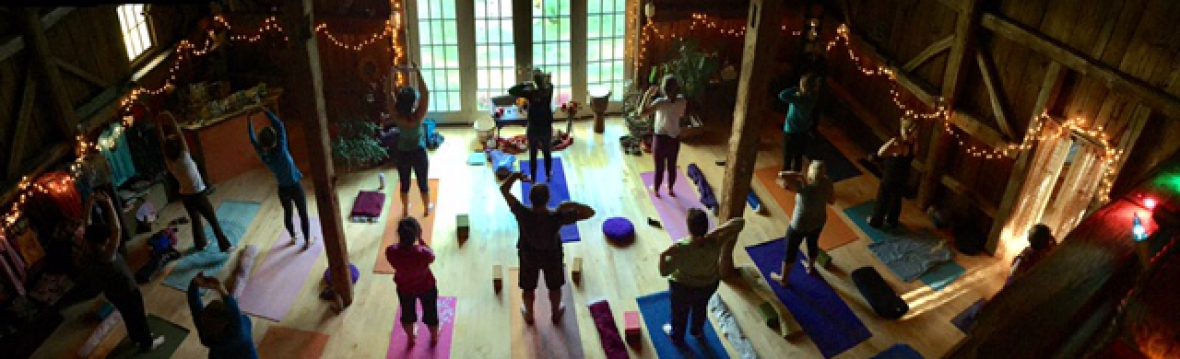

As a yoga teacher, I am often asked by my students how yoga can help us emotionally deal with the all of the conflict in the world. Every day there is something despicable and painful in the news, whether it is a mass shooting, images of a war-torn country, suicide, genocide, sexual harassment scandals, or the political circus we are watching play out in our country. Add fires, floods, the ravaging of native lands for pipelines, the melting of our glaciers, and it’s like the people and our planet are completely out of control. I don’t have answers for all of these questions and issues–I can only teach what I practice and share from the yoga mat and then actually try to walk the talk off the mat and in the world. It’s a charge I take very seriously. So when I am asked by a student or someone curious about how a modern yogi handles what’s going on in the world, pleading, “what am I supposed to do with all this?” I understand. Our hearts are heavy. We have seen, heard, and experienced so much; some are beginning to shut down and become complacent. I open up my computer today to find another shooting. We feel paralyzed, too small to make a difference, or that our words fall on deaf ears that care more about their pocketbooks than human life. We are angry and don’t know how to direct our frustration.
A physical mat practice can help us work out stress in our bodies. A meditation practice can help us unknot the stresses of our minds. A pranayama (breathing) practice can help you to channel your energy, calm or invigorate yourself. These I can share with you at the yoga studio, in a classroom, or on a mountain top, but I don’t have the keys to your heart and mind, and I can barely keep track of my own. Thank goodness for the Dalai Lama!
Although he doesn’t give all the answers, just in time the Dalai Lama responds with an op-ed adapted from his new book “An Appeal to the World: The Way to Peace in a Time of Division, co-written by Franz Alt, a journalist and bestselling author. (I’ll attach the article at the end of my post). After reading this excerpt in the L.A. Times, I am inspired once again to share my belief that now is the time to do the hard work of self checking our thoughts, words, and behavior, and now is the time for self love, meditation, and connecting. I’m doing it for me. I want you to do this for you.
At every turn, we need to defy the egocentric, exclusionist, and resent-full attitudes we encounter–even if it is in our own friends or family, and especially in ourselves! Challenge: Call these things out when you feel them rising in your own heart and mind, not just when you see/hear it in others. Be a witness and acknowledge your own tendencies, stop your pattern in its tracks, and take a moment to re-frame your response. Give others the same mindfulness before you speak up about their cruelty or insensitivity. You CAN be strong and kind in the same moment. Try it. If you don’t think you can be kind, take 10 full breaths. Get yourself together. Be constructive instead of reactive. You can do this.
We find it pretty easy to judge others, actually, and we get all hot and bothered about it on social media where we can post about it from the privacy of our own homes. Here we don’t need to look into the eyes of another human; we can post some passive-aggressive Instagram quote to “stick it” to someone and hope they get the message, and we can point fingers, spread sarcasm, and feel good doing it too. We don’t need to face the ones who wronged us or those we may have hurt. It is all a little too comfy here on the couch.
Again, some real work to get you off your seat and get started in your close-to-home personal world: forgive those who hurt you, and this might mean forgiving yourself too. Don’t just ignore your pain or resentment and hold anger in your heart (or dramatize it in conversation behind someone’s back), for this leads to violence against yourself, destroys your own peace, and then inevitably affects others. Reach out to the person with whom you have a conflict. And if you can’t, for whatever reason, do the hard work in your heart of letting go–maybe find a coach or teacher who can help you process.
All we have to do is look at all the recent episodes of violence in this country and across the globe to know how much pain we are capable of feeling and causing… so much hurt on all sides. There is no way a mass murderer could gun down a crowd of people if he truly loved and cared about himself. Self love connects us to the Source–God energy. If we deny ourselves this connection, we become deranged, unbalanced, distressed. Connecting helps us to recognize we are all part of the same consciousness, and that requires humility, forgiveness, gratitude, and to see the divine in ourselves on a day to day basis. Now that is some strong medicine when we realize the person who hurt us (or someone we care about) is of the same Source as we are. Reminder: There is no “them.” Only us.
If you are courageous enough to take that step into the often uncomfortable truth that a murderer or a saint or yourself or the president of a country are all “divine,” then we have an interesting conversation going on. How quick we are to judge others, when what we are judging is a reflection of something in our own selves (which is why we hate it so much–who would want that horrible trait or capacity?) Can we re-frame the conversation a little by asking: “how did that person become so separate that s/he can harm/disregard/deny someone else (or himself)?” When we, ourselves, feel separate, how can we dial in to the resources that re-charge our hearts with belonging? Hint: you have to believe that you (that every single person) is worthy of love.
The Dalai Lama’s wish is that we could educate the heart as much as we instruct the brain in our schools. What a concept! But before this can happen, we need to have a chat about our compartmentalizing religions and the things that separate us (skin color, language, financial status, location on the planet, etc. ad nauseum.). Throw them all up on the table, and despite the perceived differences, we will most certainly find what we share in common as human beings. Rather than see culture, skin tone, and religion as impediments, can we learn to celebrate the variety and highlight similarities? Then we’ve got some empathy going. It is time. Time to learn how to talk through conflicts with others and find peaceful resolutions that knit us back together, like a quilt of many colors and textures. We don’t need to look the same, talk the same, go to the same church, eat the same food. That is all external. Start looking inward. We already have the same blood, body functions, and physical needs. We all have human emotions, the same need for love, acceptance, peace, the same capacity to feel sorrow.
So maybe we should start here… in every school across this country–in every yoga studio, church, town hall, soup kitchen, library. This is a movement that requires people and institutions to mobilize from the heart. With all of our desire for kindness and peace, why is it so hard to get this movement started? The Dalai Lama tells us in his recent article: “empathy is the basis of human coexistence. It is my belief that human development relies on cooperation, not competition. Science tells us this. We must learn that humanity is one big family. We are all brothers and sisters: physically, mentally and emotionally. But we are still focusing far too much on our differences instead of our commonalities. After all, every one of us is born the same way and dies the same way.”
It’s time to soften our edges–to blame less, problem solve, and forgive more. This does not mean be a doormat. It does not mean we have to agree on everything. We can still be truthful and be kind. My wish for today is that each one of us takes a moment to practice self love, forgiveness, and compassion. Once we can feel it here in our own hearts, we will immediately recognize ourselves in everyone we meet. This might be a start.
Much love, gratitude, and many blessings,
~Katie ♥
To read the Dalai Lama’s op-ed piece in the Los Angeles Times, click Dalai Lama L.A.Times November 13th, 2017.


 Here is my heart’s release–a gift the fire consumed and then breathed out in a trail of smoke to the ether: I said aloud that “I let go of the need to be perfect,” but my heart also spoke these silent words to the fire: I will let go of my my fear of being alone and of being left out, my worry that you won’t like me and my clinging to relationships that produce anything other than joy; I release my fear of speaking my truth in all situations where it is necessary to do so. I surrender my need to be the perfect wife, friend, or teacher and my need to know it all at once… I let go of fear itself…the list goes on.


 Many of us walk the village paths in the morning as the sun rises over the Tamil Nadu mountains that surround the towns of Coonoor, Bedford, and Wellington. My favorite early morning walk takes us up the hill behind the retreat through Pemberly Estates, a long row of vacant second homes, all painted white with brick tiled roofs and beautiful gardens full of lilies, red passion flowers, lantana, roses, vinca and ivy, and radiant hot pink bougainvillea that the owners rarely enjoy. There are banana trees, coconut palms, and orange birds of paradise. After a month of our daily walks, I finally stop taking pictures of the poinsettias trees that line the roadway.


 In the early morning, though, the first sunlight comes up over Bharatnagar in the east and shines across the valley touching the mountaintops that rise up behind Wellington and the far away villages folded into the eucalyptus forests, fire trees, and purple jacarandas. Every morning I am excited to see the sun spread its pink light over the hills and painted villages below. At 6,500 feet above sea level, we are higher up than Mt. Washington, and the peaks are covered in scrub and dust. At home the mountains are still under a blanket of snow, but no one here has ever seen it before, so even when Annie and I try to explain, they don’t understand when we tell them our town just got two feet.


 One of the reasons I love walking this way so often is the laundry. What is menial labor for the natives becomes art for me. It is no less beautiful than a landscape painting, and there is plenty of material here to make pictures. The second reason is the villagers. Each day we see the same people beginning their day, and it is an intimate time that we feel privileged to witness, even if it would not be their choice for us to see: people brush their teeth, wash their feet, and mothers comb hair into braids. They wave to us, smile as they say “good morning,” and some, I am sure, wonder why we walk around and around their village so many mornings and afternoons. The scene is never the same twice, and there is always something new to captivate our attention, like this little family with their puppy AND their amazing laundry!


 A few days later, I am walking with Mary Jo when I see another orange tiger sitting up on a wide stump; he lets me pet him, and when I scratch his chin, I can feel his happy purr. He has big paws, rich orange stripes, and eyes like Pawsie’s.
 Another afternoon while walking with our group, I spot a white and gray-striped kitty. She is facing away from me, uphill. While everyone else stops to talk with the locals, I call to her, and as I bend down to pet this sweet baby, she turns her slender face upwards, revealing the most gorgeous cat eyes I have ever seen. They are pure turquoise, the color of Caribbean waters, and I admit, she completely takes my breath away as she looks at me. We hold each other’s gaze for a few long moments; then she blinks at me, and when the children come begging for a selfie, she steps her tiny feet off the path into the littered brush. For the rest of the day, I can’t think of anything else but this little cat.
 The next day I come back to find her, and when I lift her soft fur into my arms, and a man named Moses tells me I should take her home with me. Hold on a second. Home? Anyone who knows me will understand that this invitation leads to three nights of research into what it would take to bring this kitty all the way home to NH in just one week’s time. After losing two of my beloved kitties barely four months ago, I had no plans to take in a new pet, and Puddy Tat needs all the love he can get now, having lost his buddies… but this cat… I ask the people who owns her. What is her name? Another man says what sounds like my name. Seriously? The cat and I have the same name: Catie, I later learn, is the spelling.
 The villagers who have now gathered around are laughing that this little blue eyed kitty and I have the same name. “You take home. You take her? Take back with you.” My heart races. I have a retreat to lead! I tell them I will come back again soon, and run to catch up with my group before I can scoop her up and take her with me on the spot!
 On some walks the dogs stand guard and howl when we pass; other times they just watch us with quiet curiosity.


 Her face is worn and wrinkled ahead of her age from a lifetime carved out of this iron-rich hillside where every-day garments garner a film of rusty dust. She has washed a lifetime of petticoats and shawls, her husband’s socks and pants, tin dishes and tiffin bowls. Her wedding band glimmers on her hand, and she wears a single gold bangle. The wind brushes silver strands of hair over her frown and fill her skirt with light.
 The next day there is no laundry strung on the cord, and the white-washed stone wall is empty compared to the daily tale of life which usually hangs in the sunshade of my favorite house to photograph. The woman is nowhere to be seen, a ghost, her sidewall barren and silent of color, but its pockmarks are full of ants, and the sparrows feed happily on this day of rest.
 One day as I am out visiting the neighborhood felines (about whom I will write in my final post from this trip), a sweet male tiger rests in the late afternoon sun. His tail drips down the wall like the clothes above his long body. It is a peaceful scene. He calls to me as I walk by, and I lean in to scratch his orange head; his little chin tilts to meet my fingertips, and I am instantly overwhelmed in sweet sorrow for my Pawsie.
 Sometimes it is the paint behind the laundry that catches my eye; other times it is the sun streaming through brilliant jewel-toned fabrics. Now my eyes are drawn to plastic buckets lined up beside a communal spout waiting for each woman to collect her daily family quota of four containers which will be rationed between drinking, bathing, and washing.
 On early mornings, the laundry is a black silhouette, a shadow on the ground, shades of grey stolen by the morning light. Each time, though, it is the story of a family: school clothes show me how many children live here; if I see the same dress hanging twice in one week, I know the lady of the house probably has four dresses to pick from.
 A bit farther along the way, just before heading out of the village and into the tea path, there are small blankets and a pair of sweaters on the line, revealing the recent chilly nights way up here in the mountains. A man’s shirt hangs draped and dripping. It will be dry by noon.


