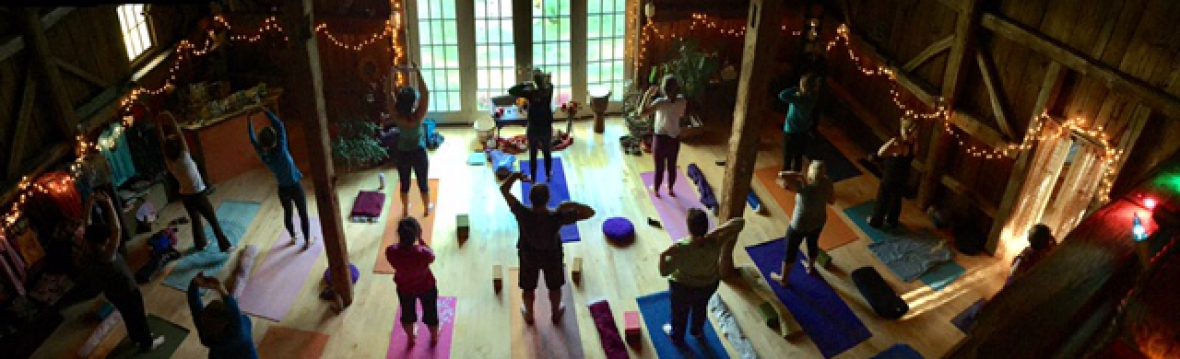
I am once again en route to India, this time passing from Boston through Amsterdam to Mumbai. It’s a 4-hour layover, and my friend Brendan and I walk mile loops around the terminal to stretch and check out the endless cheese carts and tulip shops. This is my fourth time to India to lead an Ayurveda yoga retreat, and Brendan, who I did not know prior to India, has been on the retreat every year since my co-leader John de Kadt and I began.

Already I miss my Declan, who has slept through a day of my travels at home in NH; it feels like I’ve been gone for days. At 3:45 am I am eating a warmed-up, day-old butter croissant with an Americano. I know I shouldn’t be drinking coffee right now; but it’s the croissant that requires the java—and lots of extra butter. It was after the last flaky bit that I reviewed my e-ticket and realized that what I thought was the boarding time was actually the scheduled take-off! Maybe it was the Americano, but I would bet you never saw two sleepy travelers snap awake and haul some serious biscuit to the other end of the terminal like we did. You DO NOT want to miss a flight (or any other travel connection in India, for that matter) if you ever want to make it to your destination. Let’s just say, we made it there as the last business class passengers were heading through the gate. Oh, and it is in the middle of all this that one of the shoulder straps on my backpack rips free of its housing, and Brendan has to tie the frayed strap in a knot to keep it attached to the bag Reminder: do not buy a knock off North Face backpack in Rishikesh for only $8; it will fall apart.
 A quick sunrise hop to Cochin and a bus through morning traffic gets us to the old fort city in a few hours. I’m wrecked by the time we make it to Calvin’s Inn, a homestay with a handful of rooms that open into a common dining area. Krishti, the owner, checks us in, and although all I want is a nap, we agree to go for a walk to stay awake, hoping it will be easier to adjust to being on the other side of the planet.
The western end of the island is full of street vendors set up facing the sea. There are a few little restaurants, and it’s been awhile since that croissant, so we stop for what we think will be a quick late lunch of gobi Manchurian and a red curry with coconut rice, but the meal takes nearly 45 minutes to come out, during which time Brendan is literally falling asleep at the table. I admit it is probably the best gobi I have ever had, but the wait was seriously laughable (which we did once we got past our exhaustion-inspired hunger frustration). When we finally extract ourselves from the restaurant, we head down River Street where the vendors are set up on both sides of the road, banked up to the curb sides. Brendan peeks into cart and a buys two anklets for his girlfriend back home.
In between the stalls on the beach side of the street are little walkways that lead out to piers where the old Chinese fishing nets splay across the sky. The contraption is made of gigantic wooden spider legs about 75 feet high, each attached to sets of ropes that call up the nets from the water. It takes several men to hoist the lines, which are weighted with boulders and huge hunks of old concrete that hang from ropes and act as a series of ballasts.
 After watching the process for a few minutes, Brendan and I are invited to try, so we climb up on the pier and each take one of the five ropes. The men chant as they pull in sync, and I squeal when my feet leave the ground for a second during one of the pulls.
 Farther down the street are ladies selling trinkets spread out over sheets on the ground. I stop to peek and am drawn into the wishful eyes of a girl dressed all in yellow. She shows me dozens of glittering anklets, and while she tries to get me to buy, I can feel the eyes of the sellers in the next shop waiting to see if I will make a purchase. Each one says they “have a special price” just for me. Sometimes I wish I had more than my backpack, but it is a good reminder to go slow with my shopping; I have six weeks, after all.
 At 6 pm (4:30 am at home), the boardwalk is alive with throngs of people who come out to watch the Cochin sunset. Families stroll together, toddlers in tow, young lovers lean into each other, wrists entwined, and fishmongers call out to passers by, hoping to sell off the last catch of the day. The red sun sinks into the waves, a half circle like my eyes which I can barely keep open. By the time we get back to Calvin’s it is dark, and I sit on a couch and text with Declan about the day. It’s only 8 pm by the time we say goodnight, and I fall fast asleep.
In the morning we eat omelets and fresh pineapple, drink coffee, and head toward town. Before we get a few blocks, a tuk tuk driver approaches asking if we want a “one-hour tour” of Old Cochin for only 75 rupees (a little more than a dollar). He introduces himself as Haris, and I can tell by his broad smile, he is super sweet. Without a thought, we are in his ride and tearing down the street toward our first stop on the tour: Santa Cruz Cathedral, built by Portuguese missionaries who arrived in Fort Cochi on Christmas Eve in 1500. There is a long history of its first stone set in 1505, the cathedral being spared by the Dutch in 1663 (they destroyed every other Catholic building), and then later demolished by the British when they took over the city. It was eventually rebuilt in 1887 and recommissioned as a cathedral once again.


Next stop is St. Francis of Assisi. Apparently St. Francis loved Cochi, and it is said he was interned here after his death, but his body was eventually returned to Italy. We are only here for a few minutes, but it is a sweet little shady spot on a plaza, and if it weren’t for the people pushing malas and souvenirs just outside the doorway of the church, I could’ve stayed here longer.


We slip back into the rickshaw for a spin to an arts and crafts shop, where the carpets are gorgeous, and the prices are dear. Haris tells us in advance that if we buy something here, he will receive a small percentage, but that we should not feel pressured in any way. We appreciate his honesty.
Inside there are many rooms arranged by theme (jewelry, furniture, statuary, and carpets). The salesman rolls out a ridiculously beautiful 9 x 12 foot turquoise sea of silk on silk that takes my breath away. He invites me to take my flip flops off and feel it under my feet. I am ruined after this, for every government craft shop sells hand-knotted carpets (900-1200 knots per square inch!), but none is as pretty as this blue beauty. For $8,500, I can have it shipped directly to my door! I smile as I heave a sigh, step off my dream rug, and head back to the tuk tuk.
 Next stop, and heading into the second hour of our 1-hour tour, is a visit to Dobi, an old laundry center where large-scale hand washing of linens for hotels still happens on a daily basis. Cloths are submerged in small square rooms, where the washers, each in a traditional cotton sarong, stand knee deep and scrub fabric over a huge stone with a brush. Once scrubbed, families of laundry are wrung out and hung by clipping the corner of the garment or cloth between tightly wound cords of rope.


After drying, pieces are finished off with a cast iron steam press and folded, every last bit by hand. Haris points to the brand new washing machine, the delivery box still at its feet. He suggests it will take a long time for anyone to want to use it. I already know this is my favorite stop on the tour. I love laundry lines, and I snap dozens of pictures.


There is so much more in this day… more craft stores, a beautiful mosque where a man calls in hundreds of pigeons that circle one of the temple towers several times before he throws buckets of corn and rice on the plaza where they encircle his bare feet. He passes out grain for all of us to hand feed the birds, and before long, pigeons are fluttering up to sit in waiting palms. I hold out my hands for a few minutes before this happens:


After awhile of feeding the birds, we get back in the rickshaw, Haris asks if we want to stop for lunch, and says there is a great place where the locals go. We say yes and he pulls into a side street where we park, and enter a little place where with a hand washing station. Haris helps us order, and in minutes a huge tray of veggie dishes and rice comes for each of us. There are chutneys and Dahls, a choice of rice, a coconut soup, and a banana tapioca dessert. It is the custom to eat with your right hand, so we do like the natives and dig in! Not only is it delicious, it is only 290 rupees for all three of to get completely stuffed! Sorry, no pictures—up to my wrist in curry!
Back to the tuk tuk for the final part of the tour. Haris takes us to a women’s cooperative spice company where you can but packages of every kind of spice powder or raw. Downstairs, the ladies organize piles of ginger and nutmeg:


Upstairs, they bag spices which are shipped around the world. They serve us samples of chai, ginger tea, and herbal coffee. Yum!


After 5 hours of driving through the maze of backstreets, we are dropped off on the doorstep of our homestay, and pay our sweet guide. Haris. We really owe him for showing us so much of Fort Cochin in a single day! Exhaustion has caught up with me, and even though it’s still early, I feel ready for a nap. Nightly night from Old Cochin. Blessings to you all.


 More: how I feel later on when I see the mother dog down at the bottom of the steps in the evening light with her two puppies dangling from her underside as they stand up on hind legs. Eating dinner on the top floor of Sita’s Hotel, overlooking the river. Lakshmi’s sincere hug and our wish to see each other tomorrow as she places the jingling string of silver bells on my ankle.


 Pink and green houses glow in the sunlight, and even the worn out flip flops strewn at the doorways look as though cast off of happy feet.
 Brendan reminds me of that ancient quote about blooming where you are planted, which seems to hold true here, although I often wonder how people and plants (and pets) would flourish differently if they were planted someplace else on the planet. Remember last year I almost came home with a kitten, thinking I could offer it a better life? Who am I to say? No matter; we are here, and this is the day we are given. So I will just ask you this: how will you flourish today?


 And then the light turns the tea plants the most vibrant shades of green:


 I am once again on my way to India to lead a retreat, this time with a group of fifteen people from eight states. I have a few days before and a full week after the retreat to travel, so this year we begin with the Taj Mahal. Before we land, I pray from the skies that our fragile planet below can hold; that the people down there inside the map I am studying are safe and sound tonight; that we humans can treat each other with love and compassion; I pray for peace as midnight delivers us into the coming day.
 Our driver pulls into a gas station to fill up and take the first 2,000 rupees of our down payment. I use the filthy bathroom and am grateful for the wad of tissue I find stuffed into the outer pocket of my fleece jacket. Little things.
 Two hours go by before we stop to grab a snack of masala spiced peanuts and to use the restroom. The sun is fully up now, and for the first time I want to peel my coat off and relish the warmth. Nearby a minivan door slides open, the hatchback lifts, and I kid you not, eleven people pour out of the van into the rest area: ladies in saris, little girls in dresses, men in skinny jeans and a variety of fake leather coats and parkas. Everyone takes off a layer. For a moment I watch, mesmerized. We drive away into the sunshine with our peanuts and water bottles. Next stop: Agra.
 We follow Hari inside the complex, and he explains a bit about the masonry and stone inlays on the buildings that surround the Taj. He is already telling us about the marble factory tour we will visit next and seems to be rushing us along. The details of the external buildings are exquisite, and I am trying my best to listen to Hari who rattles along too fast to really hear him, so that eventually, I admit, my ears turn off. Have you ever been in a place so beautiful you just don’t care how it was made or came to be? I can tell by Brendan’s face he wants to be done with Hari too.


 Before we enter the central tomb, the line of tourists stops to slip white elastic booties over our shoes. The collective shuffle of feet up stairs and through portals is a whisper as voices bounce along the marble walls. We are told “no photo,” and enter the place where the queen reclines under the carved coral lotus flowers and jade leaves of her marble coffin. People toss coins into the tomb. We are out of the room in less than three minutes. Already the light of the day is changing, and the front of the Taj is no longer gleaming white: now long lines and gray shadows creep into her pale face, but this only enhances the sculpted facade and semi precious stones decorating the archways.


 We decide to stay until sunset, still hours away. People from around the world sit basking like us, just soaking up the day. No one is in a rush. Even the monkeys take their time as they parade across the steps of the Shah’s mosque toward the Yamuna River overlook.


 Before we turn to go, I take a final look at this gorgeous monument. All at once I am overwhelmed with the knowledge that I am loved as much by my husband as Mumtaz was by her Shah Jahan. It is a sweet and tender knowledge.


